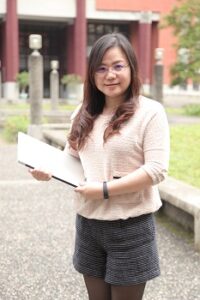
Professor Ting-Chia Hsu
National Taiwan Normal University
Designing Future-Ready Learning: AI, Computational Thinking, and Language Education in Practice
This keynote speech presents research on integrating computational thinking (CT) and artificial intelligence (AI) into empowering learning through innovative pedagogical designs. A series of studies are introduced that combine communicative language teaching with CT-based game environments, including the development of the “Robot City” learning system and its mobile-based extensions. These approaches engage learners in authentic language use while practicing core CT concepts such as sequencing and iteration. In addition, an AI-powered image recognition application is presented to support vocabulary learning in real-life contexts through self-regulated learning model. “AI2 Robot City” is further integrated with Generative AI and AI literacy into the CT game-based learning process. Taiwan AI literacy framework for K-12 teachers and students will be also presented. By bridging AI, CT, and language education, this work highlights how interdisciplinary design can enhance learner engagement, personalization, and meaningful learning.
Personal Profile
Ting-Chia Hsu is a Distinguished Professor at National Taiwan Normal University, specializing in computational thinking and AI literacy. She has received major awards, including the APSCE Early Career (2018) and Distinguished Researcher (2025) Awards, the MOST Wu-Da-Yu Memorial Award (2018), and the Future-Tech Award (2020). With 50+ SSCI publications, she has strong international impact and has held visiting positions at NIE (2011), MIT (2019), and Vilnius University (2024). She is a textbook editor, conference leader, PI of the MOE Big Data Microprogram (2023–2025), and Editor of the Taipei AI Education White Paper (2026).
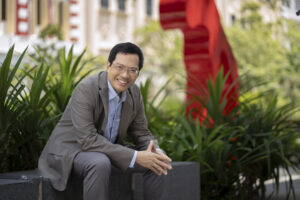
Professor Feichin Ted Tschang
Singapore Management University
Rethinking Human Advantage in the AI Era: Why Experience Still Matters for Cognition
Advances in large language models (LLMs) have reignited debates about how powerful artificial intelligence is, and whether it can replace many human tasks. However, humans still hold advantages in work settings where judgment, experience, and knowledge matter. My talk starts by summarizing some of the research illustrating differences between human and machine intelligence, and focuses in depth on one key difference: the human experience of the world. In particular, experiencing involves individuals’ attention to contexts, what they find salient, how they interpret meaning, and how purposes evolve over time. One particularly illustrative activity involving these processes is explorative invention, and exemplars are provided. This distinction of human cognition as being “grounded” has implications for knowledge management and organizational work. I discuss the implications for human–AI complementarities, and how the role of human cognition could be reframed to reemphasize human roles at work.
Personal Profile
Feichin Ted Tschang is an associate professor of strategic management in the Lee Kong Chian School of Business at the Singapore Management University. He conducts studies design and innovation processes in contexts such as videogames, virtual worlds and artificial intelligence (AI), and more recently, the cognitive aspects of human-AI interaction. He’s published on innovation in management journals such as Organization Science, and on information systems topics in journals as Management Information Systems Quarterly. He has worked at the Asian Development Bank Institute on software industries and the digital divide, and at the United Nations University. He holds a Ph.D. in public policy and management from Carnegie Mellon University, as well as graduate degrees in electrical engineering and economics.